I do believe that Lyn and Andra are some very perfect hosts as you can judge from the photos which Don provided. I really like having a photographer because my photos are not great.
The food was tremendous. The margaritas were awesome and the wine flowed.
Ian auctioned off two of Andra’s creations and the happy shoppers are pictured here wearing the fabulous shirts. Thank you so very much Lyn and Andra. Hopefully we made a good impression on Chris, a young woman who was helping serve and keep us well feed.
Gill and Chris arrived in high style but, Chris left in even better style as demonstrated in this photo.
Next week, August 12th, we are back at Kiwanis. Our guest speaker is Erin Burden and she will be speaking on her luna cup initiative in Zimbabwe.
Symphony by the Sea has been an almost annual event in support of the Symphony and this year, the Symphony by the Sea will take place on Saturday August 9 at Maffeo Sutton Park at the Band shell. The "free" concert starts at 6PM and features Calvin Dyck, members of the Vancouver Island Symphony, soloist Ken Levigne and several other musicians.
Jim sent email on Monday letting us know that he seemed to have enough volunteers except for one task. He needs four (4) people to help him and Warren to put up tarps at the back of the band shell. He will need people starting at 9 A.M. If you still haven’t volunteered for this, please make sure to contact Jim at jim@turleysflorist.com or 250-754-6344.
HUGE IMPORTANT MESSAGE – We have not host families for Bas Bakker who is our inbound Exchange Student. It is of great importance that we identify his first host family and pass along this information to him and his family ASAP. Even though Bas will be attending Dover Bay, the host family does not need to live in the Dover Bay catchment area. In Holland, Bas travels 1 ½ hours by bus to get to his school. Also, host families can be and often are non-Rotarians.
Happy week everyone.
As always, errors and/or omission should be reported to moi.
Each day starts with an assessment of the weather forecast. How far out can we go? How much do we push to get to a village? Is there another route? How do we get to our work today? When the work is in remote rural Bolivia, traveling to work may be slow, but it is possible, at least until the asphalt ends. The rainy season usually lasts until the end of March or at the very latest the end of April, but not this year. Even as I write this on July 23, we are worried about rain tonight. We sent staff into the field as far as 8 hours away this morning to train villagers and monitor water systems. We have one staff member out with a large truck delivering supplies into villages for construction of Eco Latrines. Hopefully they will all make it back before the rain starts. Looking out the window seem to always be an anxiety-provoking experience. We cross our fingers and pray a lot.
I want to point out that our staff is out there doing this work that sometimes seems impossible. They are persistent and committed to getting our projects on the ground up and going. They negotiate, plan, leave at the crack of dawn, walk thru mud, water and lord only knows what else. They get to the river that we usually can cross in a 4-wheel drive truck. Then they park, take a canoe, and hitch a ride with a motorcycle on the other side to make sure they are in the village to complete a hygiene training. I am constantly humbled by their dedication to get these projects done.
We thank each of you for funding this work and we want you to know that despite the rain we still plan to build 51 ecological composting latrines; train health promoters in 11 villages; monitor all past water, sanitation and health projects; and continue the safe water & hygiene training for four villages who received their systems last year. Our dedication and persistence is only matched by your belief in and support of what we do.
Thanks for being a part of our TEAM!
We relish your written or verbal comments and we will never say no to financial input to the team cash flow! GO TEAM!!
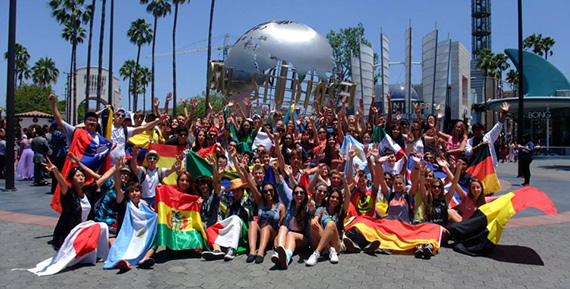
Victoria Alvarez and other youth exchange students during their trip to the West Coast of the United States.
By Victoria Alvarez, a Rotary Youth Exchange student from Argentina to the United States
Most of you have probably heard of Rotary Youth Exchange, and maybe some of you have even been involved with the program. I recently completed my exchange year in the United States, and wanted to share the perspective of someone who has just taken part in one.
I come from Argentina, a little country on the edge of South America that you may have heard of recently because of the World Cup. It is in many ways very different from the United States. In signing up for an exchange to America, I stepped out alone into a culture unlike any I had experienced, in an unfamiliar environment, in a house I did not know, to live with people I did not know. Leaving behind family, friends, and most of what was familiar.
And despite all that, or maybe because of it, this year has opened my eyes and helped me grow as a person far more than any previous year in my life. How many teenagers can say they helped other Rotary members with a Rotary Youth Leadership Awards (RYLA) event, taking part in planning and learning leadership skills alongside other young adults? Or how many teenagers can say they are not from one country but two? That they have learned to appreciate the beauty in simple things? That money can never compare with love? And that hard work can make all the difference and give you more than you could ever ask through the joy that comes from helping others and doing good in the world?
These are some of the valuable things I learned during my exchange. I have learned there’s more than one way to do things, that things are not always black and white. Humans are the same everywhere, we just do thing differently and speak different languages. On the inside, at the heart level, we are all the same.
I can honestly say my exchange assisted me in differentiating right from wrong. But more than that, I can see that different is not always wrong, it is just different.
I built friends over a period of a year, and sometimes even in the course of a single week — friendships that I hope will last a lifetime.
So, I say to you, if you have the opportunity of hosting an exchange student, please do so. You will learn as much as the student you host. And if, through Rotary, you have the opportunity to go on Youth Exchange, go for it. You will never regret it.
During my stay in the U.S., I took part in a trip to the West Coast with other exchange student from all over the world. I am hoping to be able to reunite with some of them during Rotary’s International Convention in São Paulo in 2015.
Finally, I say thank you Rotary, and all who support the Youth Exchange program, for this awesome experience, one that you give to more than 3,000 youth a year.




 I do believe that Lyn and Andra are some very perfect hosts as you can judge from the photos which Don provided. I really like having a photographer because my photos are not great.

 Ian auctioned off two of Andra’s creations and the happy shoppers are pictured here wearing the fabulous shirts. Thank you so very much Lyn and Andra. Hopefully we made a good impression on Chris, a young woman who was helping serve and keep us well feed.
 Gill and Chris arrived in high style but, Chris left in even better style as demonstrated in this photo.