|
|

|
|
|
|
Posted
on Jul 09, 2014
|
by Susie Ma
Rotary’s new president, Gary C.K. Huang, shows us the meaning behind the family of Rotary.
Gary Huang played a lot of sports when he was younger, but basketball was his favorite. He was captain and point guard of his high school team. “I’m not tall, but I was quick.” He flashes a grin. “I knew how to move the ball and set my team up to win.” That was decades ago, but whether in basketball, business, or Rotary, moving the ball continues to be Huang’s game. He likes action and progress. He relishes a challenge. When the Rotary Club of Taipei told him he was too young to be a member, he persisted, attending every meeting for nine months until he hooked an invitation at age 30. Since then, he has not stopped moving forward. Five years after joining Rotary, Huang became club president. Then he became Taiwan’s youngest district governor, first RI director, and first Rotary Foundation trustee. This month, he becomes the first Chinese president of Rotary International.
Huang was born in Fujian, a province in southern China. He is the third child of seven. Like many others, his family fled China during the civil war, unhappy with the communists who were taking over the country. The family settled in Taiwan in 1947, when Huang was one year old.
Huang’s parents pushed him to excel in school, but they also believed that grades were not the only things that were important. “My father used to say to me that getting B’s was OK, but I had to participate in activities and join clubs. He said that would help me in the future,” Huang recalls.
Although Huang’s father was not a Rotarian, he instilled similar ideals of service in his son. Helping others, his father said, would help him learn how to be a leader. As a result, Huang was president of his high school class. Besides playing basketball, he played soccer, ran track and, at the urging of his mother, participated in (and often won) speech competitions. He also led the daily morning pep rallies at his school for six years. “My father was happy I did those things,” Huang says. “Every time there was a school celebration, no matter how busy he was, he would always attend.”
After high school and two years of serving in the military, Huang moved to Michigan to attend the University of Eastern Michigan in Ypsilanti. He recalls those years with fondness, remembering how clean and wide-open the Midwest felt to a city boy from Taipei. He lived with an American family, who gave him the name Gary because they liked the actor Gary Cooper. He worked through school at a gas repair company, where he started at $1.25 an hour and ended at $4.75 a few years later. When he graduated with a business degree in 1971, he was so happy, he bought himself a graduation ring. “It was the first, most expensive thing I’d bought with my own money, so I wear it all the time,” he says.
But his education was far from over. Huang’s father was president of an insurance company in Taiwan and wanted his son to be well prepared for a career in the same field. Huang went on to graduate school at New York University and spent time in England, Switzerland, Germany, and Japan, learning about the insurance business and making international connections. Years later, Huang would again be making connections all over the world as RI president.
Huang returned to Taiwan to work for a small insurance firm, which over the next 15 years he built into one of the largest in the industry. He made one agreement with his chairman: that he had to be able to fit Rotary into his busy schedule. “I wanted to continue my work in Rotary no matter what,” he says.
When Huang began to experience success in his profession and in Rotary, his mother kept him grounded, something she still does at the age of 95. “I know she is proud of me,” he says. “But no matter how successful I am, she never praises me.”
|
The year Huang joined Rotary was also the year he met his wife, Corinna Yao, at a church Bible study. “He kept calling me,” Yao says. But Huang remembers it differently. “She’s the one who picked me up!” he claims.
He was outgoing and social. She was an introvert. “I wondered how we would get along,” she says. “But it’s 38 years later, and we are still good.” Together they raised three children – two daughters and a son – and now they have two grandchildren, Eddie and Evan. Evan was born on the same day that Huang found out he was the RI president-nominee. His name is a play on “Evanston.”
Huang and Yao raised their family with Rotary, so it plays a part in their children’s memories. “I always wanted what you had with your Rotary friends. Growing up, they were my aunties and uncles,” eldest daughter Linda tells her father. Nancy, his second daughter, remembers visiting an orphanage with Huang when she was young. “It was the first time I learned about what Rotary does. My dad was so passionate,” she says.
The orphanage was one of the first Rotary projects that inspired Huang more than 30 years ago. When he toured the facilities, he was taken aback, seeing the kids crammed into one room at night, watching them share a pot of rice at mealtime. Many of the orphans were the same age as his young children at the time. The orphanage needed so many things – a new roof, a refrigerator, an air conditioner, and diapers and other supplies. The Taipei club provided these things, but Huang wanted to do more. He and another Rotarian decided to sponsor two of the girls. They chose two four-year-olds with the same Chinese zodiac sign as Huang and his friend: the rooster. They took the girls to dinner once every other month. They paid for the girls’ school fees every year and eventually sent them to college. After graduation, they paid for a celebratory trip to Hong Kong and helped them find jobs when they came home. Thirty years later, Huang and his friend still meet them regularly for dinner, now with their own families.
Huang believes that Rotary should be about lifting people up. The theme he chose, Light Up Rotary, is a reflection of his desire to encourage Rotarians to bring light where there is darkness. Huang also hopes that Light Up Rotary inspires Rotarians to lighten up Rotary’s image. He wants Rotary to be fun, not just for fun’s sake, but because having a good time builds genuine bonds of friendship, retains members, and helps recruit new ones.
Member recruitment is a hallmark of Huang’s Rotary career. When he was club president, his club grew from 102 to 138 members. When he was district governor for Taiwan, Hong Kong, and Macau, he added 19 new clubs. “If you want to invite people, you need to make things interesting,” he reasons. “Then they will love it and come again.”
Huang’s friend and RI Vice President Celia Elena Cruz de Giay supports this approach. “Rotary is a serious organization but not a solemn one. President Gary is putting an emphasis on making Rotary fun because he can see the winning combination of Rotarians having fun while they serve,” she explains.
He also champions the idea of opening Rotary’s doors to younger people and recruiting more female members. “Some Rotarians are too conservative. They disagree with having women or younger members,” he says. “With younger people, they are our future. In a few years, they will be bigger, better, maybe richer than us,” Huang jokes. “It’s good for them, good for Rotary, and good for society.”
Even though he jokes, Huang is so serious about membership that he recruited his own family into Rotary. His wife joined first, then his three grown children followed suit, each in a different club. His son, Billy, believes that being in Rotary has made the family closer. “We participate in activities together,” he says. “I understand my dad better.”
Huang is thrilled to bring together the most important parts of his life, giving new meaning to the idea of the family of Rotary. He hopes that others will follow his example. “Why leave your family to do your Rotary work? You can do it together,” he suggests. “Then doing good becomes a family event.”
These days, Huang plays golf instead of basketball, but he’s still in the game of setting up his team – the team of Rotary – to win.
|
|
Read more...
|
|
|
Posted
on Jun 20, 2014
|
|
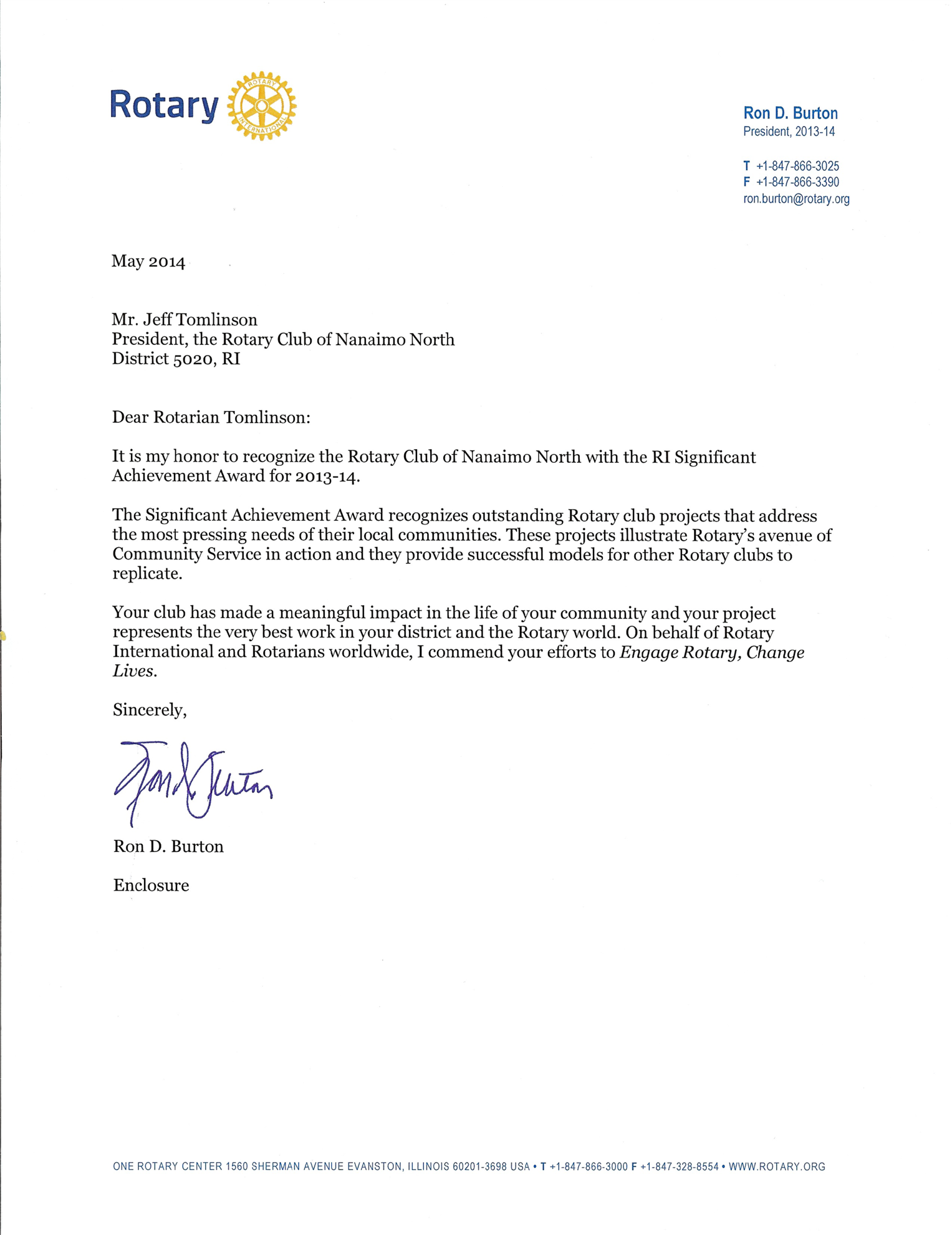
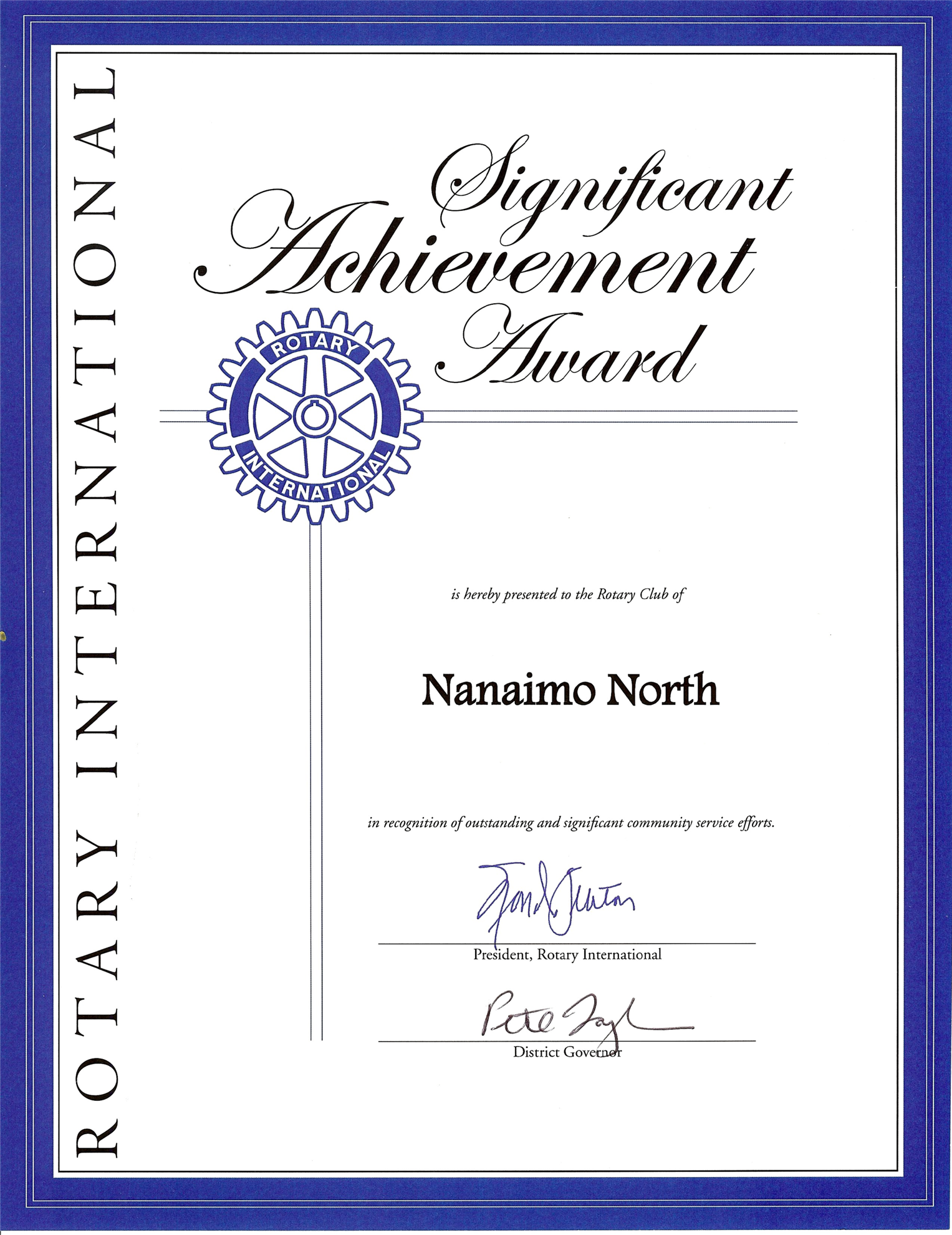
Our club has received received the Rotary International Significant Achievement Award 2013/14 for our community breakfast program!
Letter from RI President Ron Burton .
Certificate signed by President Ron Burton and District Governor Pete Taylor
|
|
|
|
|
|
|
Posted by Bill Robinson
on Jun 14, 2014
|
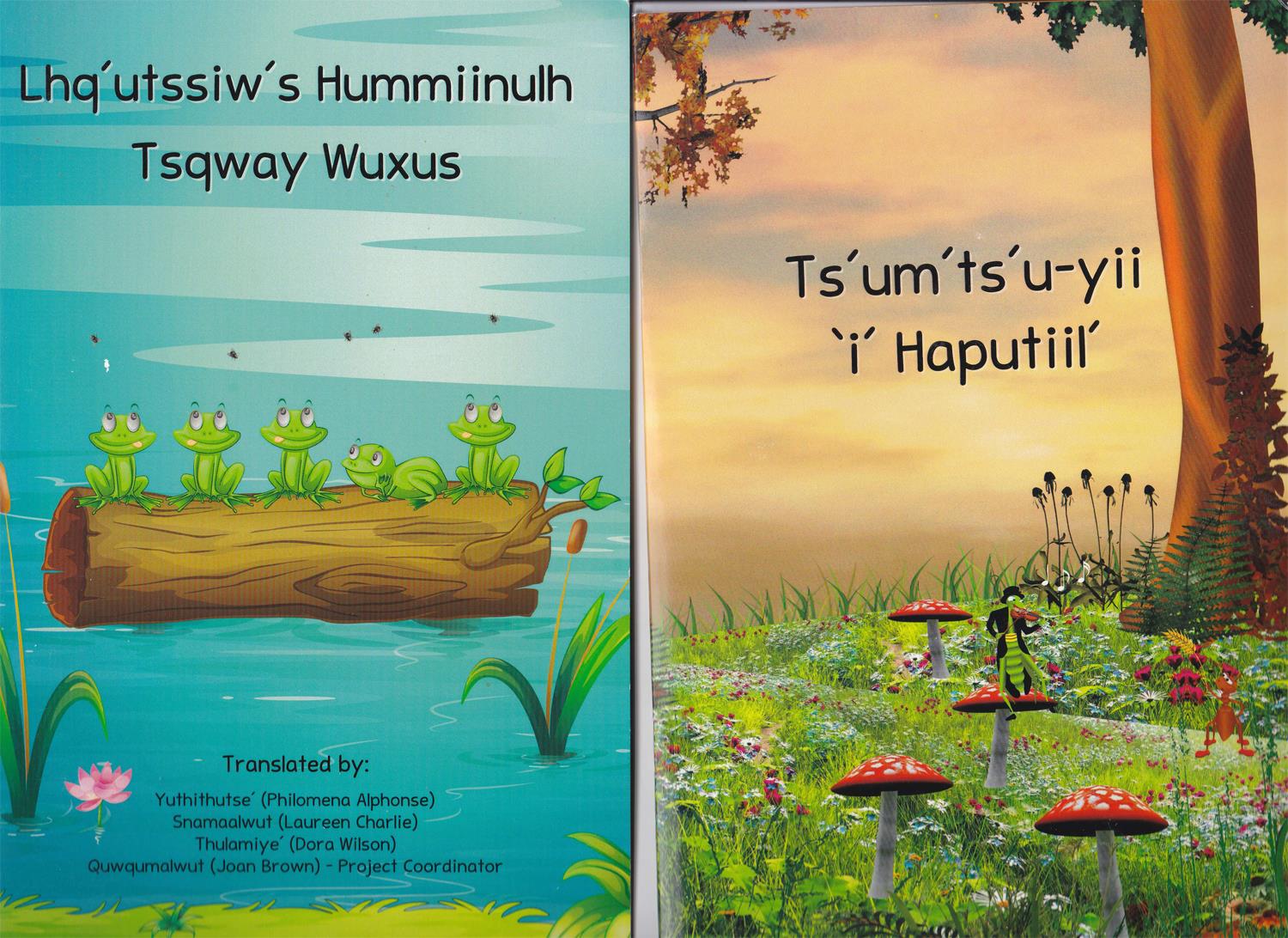
The club recently voted to print 100 copies (3 classroom sets plus 10 spared) of each of the books pictured here. They will be used by the three Hul’qumi’num teachers in SD68 each of whom rotate through a number of classrooms. All three have seen sample copies of the books and are excited to be able to begin using them starting next September.
The SD68 Multicultural and Race Relations Committee, chaired by member Bill Robinson, a trustee, is working to introduce more Hul’qumi’num language and culture into the district’s schools through introducing more Hul’qumi’num signage and verbal language into the day to day experience of students. Our club has also provided volunteers at two Truth and Reconciliation events this year, which has helped to move this goal forward.
|
|
|
|
|
|
|
|
|
|
|
|
|
|
|